
Subscribe for exclusive deals.
We do not share or sell your information.

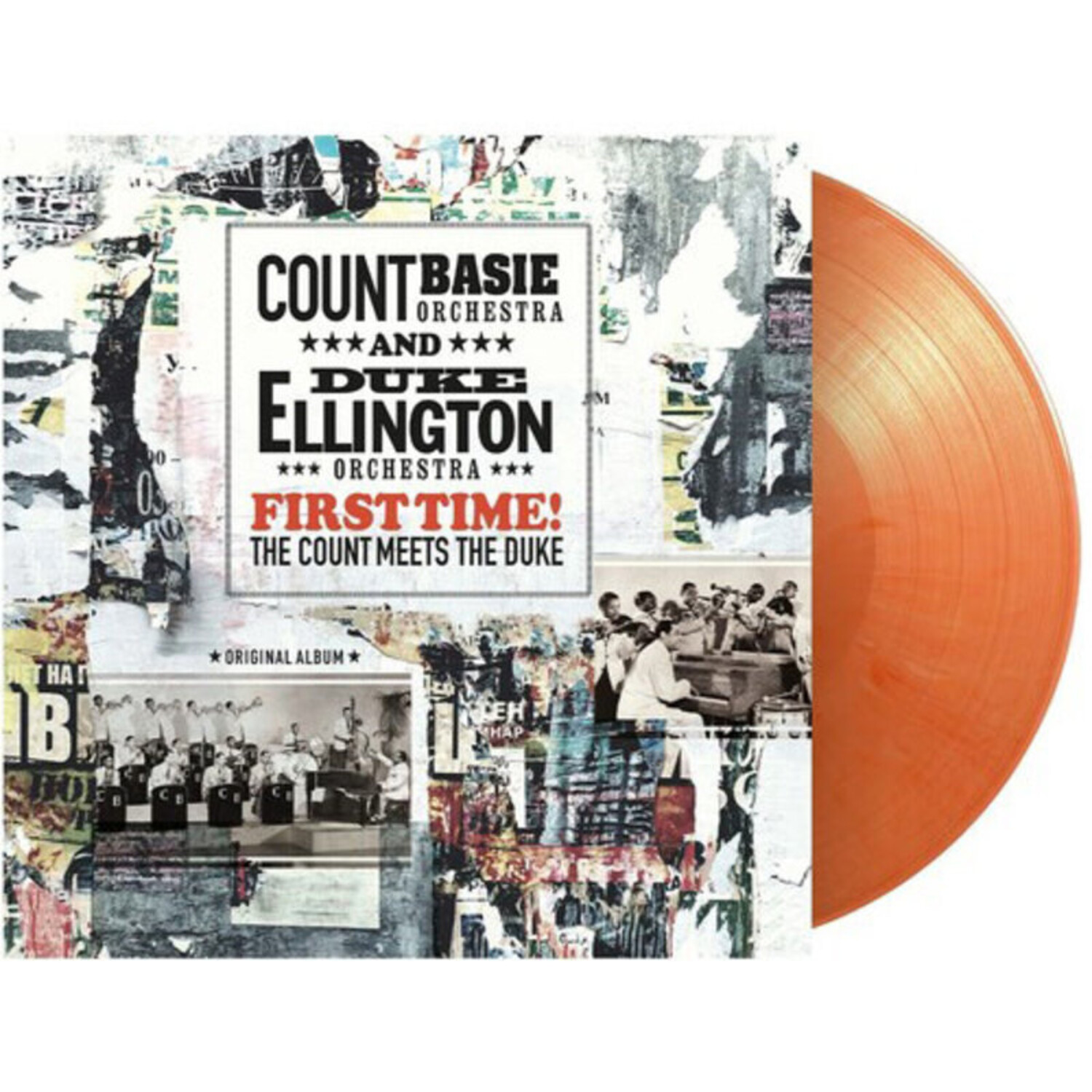




Big band jazz fans should really go for this album. A host of jazz stars are included in the full complement of both bands which are pitted against one another. The two leaders trade piano solos of the tracks and the likes of Paul Gonsalves, Johnny Hodges, Frank Wess, Willie Cook and Budd Johnson hook up in instrumental duels. The set makes for swinging listening with representative tunes from both bands’ books ( Take the “A” Trainand Jumpin’ at the Woodside are typical ) included. Program has pace and drive and should be one to watch.
This first meeting of the combined Basie and Ellington bands has fortunately not been conceived pugilistically. There is a welcome minimum of competitive tension, although there are moments, as in the opening and closing tracks, of gratuitous blasting. Most of the set, however, is relaxed and absorbing within its limitations.
The main limitation stems from the fact that the entire album was recorded in one session without any rehearsal. Accordingly, there was not time for the kind of careful scoring and preparation that could have taken fuller advantage of the different styles and textural colorings of each band. A successful balance between Ellington’s harmonic subtlety and Basie’s riff-built simplicity is achieved in places, especially the slow Segue in C, in which soloists and sections from the two orchestras are intriguingly juxtaposed. That one track and the following number, B D B, warrant adding the album to a jazz collection.
The other limitation is that the soloists are uneven, and even the better contributions are usually too short. Both drummers, moreover, are stolid in the medium-and up-tempo numbers. Nonetheless, there are passages of sharply contrasting expert solo work, and the occasional dialogues between the two leaders are pointed and witty. Columbia’s sound engineers have balanced the parallel forces with taste and a great deal of acсuгасу.
The fun begins when Ellington and Basie take turns on solos and then back up other soloists together. They never get in each other’s way, but they comment on each other, repeating a phrase, twisting it slightly and occasionally throwing in entire passages in each other’s style. That’s when you need stereo to follow the rare and skillful kidding. It’s a jazz conversation between two giants, charged with musical repartee and backed by two of the finest bands in the land.
THIS is the kind of meeting of which dreams are made … Count Basie on one piano, Duke Ellington on another, their combined 30 pieces wailing together like a heavenly jazz choir. The only description that fits is “too much!”
Most of the tunes are Ellington’s but, being the Duke’s, they are part of the basic language of jazz and
the Count and his men have long been familiar with them. There is no rivalry between these two great remaining big bands. The two pianos seem to be conversing. Lawrence Brown’s sax wails awhile and is answered by Johnny Hodges. Cat Anderson and Thad Jones exchange trumpet pleasantries. It could well be one band instead of two.
But very few large jazz bands, even with these assets, have produced music which approaches in value the works of the best small combinations, from Louis Armstrong’s early bands to Miles Davis’ recent quintets. The big-band advantages, after all, have their pit-falls. Power and dynamic contrast are more or less relative-in this respect, a five-piece band can knock your hat off. As for richness of musical texture and color, these can speedily become a great resplendent bore if they are not part of some strong compositional design. And jazz composition has so far seldom been sturdy enough to support the sumptuous robes it has often been asked to wear. Most of the big power bands of the Swing Era, and their few successors, sound more or less blasty, heavy, and mechanical, and their ventures into gorgeous drapery are apt to be flagrant cases of musical overdressing. And so, as I say, I continually revert to the music of the small bands, ardent, supple, simply attired. So far as I am concerned, it might be said that the “chamber music” of jazz is vastly superior to its “symphonic music.” have nothing but good wishes for its “symphonic” men, but in jazz, as in music generally, I find the chamber intimacy the prime glory of the art.
These thoughts arise upon listening to some of the new big-band discs, of widely different styles. Following the Morgan-Guaranty and Chase-Manhattan mergers, we now have a temporary Ellington-Basie alliance. In The Count Meets The Duke, the two most famous and durable big bands in the nation come together for the first time on wax ( Columbia CL 1715 ). The pow-pow is peaceful, rather than a battle of music, the two outfits combining into an orchestra of thirty men, fourteen of whom take solos. They play numbers from the repertoire of each band. There is a certain amount of ponderosity; there are a few hectic tutti; there is none of the solo brilliance heard from these outfits in the past (such men as Johnny Hodges, Lester Young, and Buck Clayton come to mind). But there is a good deal of the stately, hieratic swinging which these priesthoods have made famous, especially in Segue in C by Basie’s saxophonist-flutist Frank Wess, and “BDB” by Ellington and his alter ego, Billy Strayhorn. Altogether it is a ritualistic occasion, and I find much of the ceremony enjoyable.

